


Why Don’t American Homes Last 400 Years?
The home my grandparents bought at the start of the Depression will soon be 100 years old. Family lore says they paid $4,000 in 1930 ($73,300 in 2024 dollars) for one-half of a brick-and-concrete duplex in what was then in a distant corner of Brooklyn. The current owners have a property valued at more than $1.5 million today.
Aside from price, the Brooklyn home has one other unique feature: It has managed to last almost a century while “the average lifespan of a house in the United States is between 50 and 63 years, from construction to demolition,” according to MIT Architecture.”
In comparison, explains the European Business Review, the typical European home is “built to last 400 years (estimated) without requiring major renovations.”
Even if European longevity estimates are off by 50% we’re still looking at several centuries of occupancy and use.
Our persistent underbuilding crisis might fade away if homes lasted longer, a lack of supply that pushes up home prices and reduces affordability. In February, Realtor.com estimated that “the market is still missing up to 7.2 million homes, the result of more than a decade of underbuilding relative to population growth. New construction approaches are needed because the house you love, renovate, improve, and hopefully pass down to your heirs will increasingly be valued on the basis of its chips, battery capacity, and ability to withstand wind, rain, and fire.
“Homes are built to last 50 or more years,” the National Association of Home Builders (NAHB) explains. “No one has a crystal ball to know exactly how people will be using their homes that far into the future, but several features are strongly trending. Building professionals may want to consider voluntarily including such features in their homes today to set their clients up for the next 10 to 20 years.”
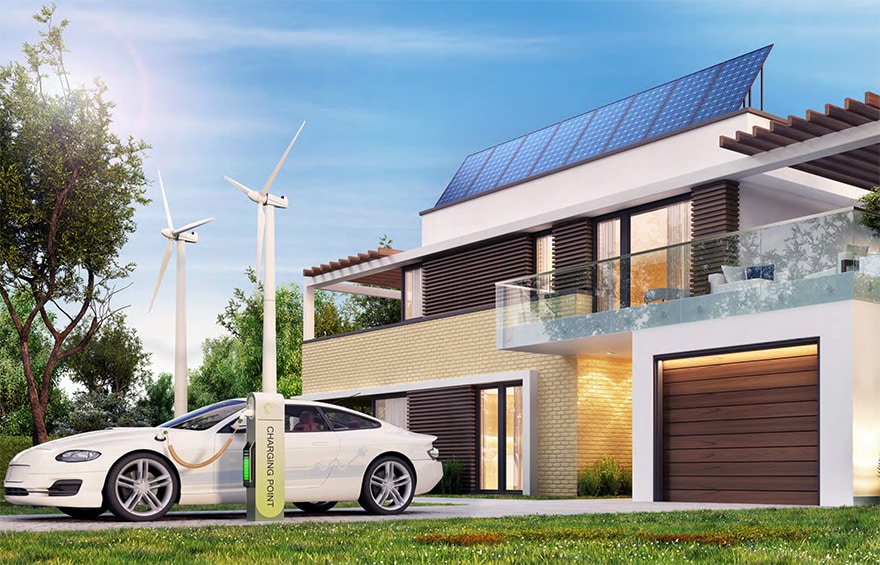
NAHB wants pre-wiring because it expects more consumer demand for electrified vehicles that can be powered from home. According to Experian, there were 3.3 million electric and 8.4 million hybrid vehicles on the road in the fourth quarter. That’s about 4.1% of the market, a figure that with federal tax credits and increasing public interest is expected to rapidly grow.
Pre-wiring and rewiring the housing stock will inevitably happen as electrified vehicle sales increase and auto prices decline. Tesla prices, as an example, fell more than 20% between January 2024 and a year earlier, according to Cox Automotive.
The Way The Winds Blow
A lot more must be done to produce homes that routinely last several centuries. Several such changes are now underway, in large part because of changing weather patterns.
Each time you read about a massive flood, hurricane, wildfire, tornado, or other natural disaster, the need for a stronger housing stock becomes more obvious. Such events produce enormous direct losses, but they also do something else: They increase insurance claims and those claims result in higher premiums, bigger deductibles, and more cancellations.
S&P Global Market Intelligence reports that 2023 insurance premiums for owner-occupied homes jumped 11.3%. The increases were far higher in several states, including Texas (23.3%), Arizona (21.8%) and Utah (20.3%).
According to a September report from the First Street Foundation, “there are approximately 6.8 million properties across the country that have already been hit by increasing insurance rates, canceled policies, and the realization of property value devaluation due to increased cost of ownership. That 6.8 million is a small fraction of the 39 million properties across that country that face similar insurance-related corrections based on their similar risk to those already being affected.”
Most residential properties are insured. If a property secures mortgage financing then insurance is required, it’s not an option. The government’s Office of Financial Research (OFR) estimates that “77% of U.S. homes are financed with mortgages and are subject to insurance purchase requirements regardless of cost.”
In other words, if you can’t get insurance, you can’t get a mortgage. And if you have a mortgage and don’t keep up coverage, you can be charged for “force-placed” insurance purchased by the lender. Ultimately, you can be foreclosed if you don’t have required property insurance.
Higher premiums and outright cancellations are bad for homeowners, but other nasty problems loom in the background.
“Insurance industry challenges,” said OFR, “impact property owners, property users, real estate lenders, including banks and government-sponsored enterprises such as Fannie Mae and Freddie Mac, and governments that collect property taxes since insurance cost and availability contribute to determining whether new property developments are economically feasible, where they can be built and their cost to build and operate.”

The New Housing Stock
Millions of existing homes must be remodeled and updated to reduce insurance costs. Uninsurable homes will inevitably be torn down or moved to safer areas, whichever makes more financial sense.
New construction will be built to higher standards, and since that’s the case why not emphasize residential longevity?
Consider bricks. Some of the oldest structures in the world include bricks, but even so, new ideas continue to emerge. Renco USA is making interlocking bricks that resemble Lego blocks, an idea it found in Turkey.
“We did our impact testing for Miami-Dade County and we reached our approvals through Tallahassee,” company President Ken Smuts told CBS News last year. “We’ve tested this up to a failure point of over 250 mph wind. A typical concrete block that’s not reinforced breaks in compression at about 1600 PSI, this block breaks at 16,000 PSI. That’s 10 times stronger.”
Faswall offers the ICF Block System, an insulated, interlocking wooden block long used in Europe. The composite materials, it said, “are all Natural, and last for centuries, based on proven building techniques in Europe.”
In Texas, Icon Technologies uses 3-D printing to create houses, with walls made from layer-upon-layer of concrete. It has projects underway in Georgetown and Marfa, TX.
In Germany, PERI produces a 3-D printing machine that can do much of the heavy work needed to build homes. The equipment can create both free-form and traditional straight walls. Its technology has been used by Habitat for Humanity in Arizona to construct a concrete home in Tempe. The home has three bedrooms, two baths, and 1,738 sq. ft. of living space. According to the group, “70 – 80% of the home is 3D printed, including all internal and external walls. The remainder of the house is a traditional build.”
New technologies can speed construction, thus saving costs upfront. There can be design and sustainability features, including construction lasting far longer than 50 or 60 years. Concrete is fireproof and highly wind-resistant, good news in the event of hurricanes and other natural disasters.
Walls are not the only changes that need to be made with new homes. Plumbing will be engineered so it can be easily replaced decades from now. Electrical systems will be modular and easy to upgrade. More space will be dedicated for home office use, and designs will likely favor split-bedroom floor plans to accommodate ADUs – accessory dwelling units that can be used by family members or rented as a separate residence.
Home Energy Delivery, Storage, and Production
Power and who generates it will surely be a big issue for future homeowners. There are already geothermal heat pumps and residential wind turbines.
More than 4.2 million US homes now have rooftop solar systems, according to SolarInsure, a number that grows monthly. Despite so many installations, questions remain. For example, will we see an increase in ground-mounted solar systems? Will the number of community- and neighborhood-based systems grow? Will homes have connections that permit them to be powered by electric vehicles during emergencies, technology that’s already available?
EnvironmentAmerica explains, “Electric car batteries hold an average of 69.5 kilowatt hours (kWh) of energy, enough to provide backup power to an average U.S. household for two days. Larger electric vehicles like buses and trucks have even bigger batteries and can provide more power.”

“If equipped with vehicle-to-grid (V2G) or vehicle-to-home technology,” it adds, “those cars, buses, and trucks could prove invaluable during future blackouts. People could rely on their cars to power their houses. Municipalities, transit agencies, and school districts could send out their fleets to the areas most in need. We could power homes, shelters, and emergency response centers – and could keep people warm, healthy, and comfortable until power could be restored.”
Interestingly, there have already been Tesla Homes, a Toyota Net Zero Energy House, and a model Honda Smart Home.
Many homes will be built with an eye toward multi-generational use. The Pew Research Center reports that according to Census data from 1971-2021, “the number of people living in multigenerational family households quadrupled during that time period, reaching 59.7 million in March 2021. The share more than doubled as well, to 18% of the U.S. population.”
These changes will no doubt create new costs and savings, but with fresh technologies homes will better serve their purpose, last longer, and push less tonnage into landfills. They also can create new family wealth as homes are passed down for generations, physical assets that often hold their value – and more – in the face of inflation, just like that little house in Brooklyn.